Tuesday, August 4, 2015

The Nuffield Experience

My last Nuffield trip is now in the books; the suitcase is unpacked and life is slowly returning to normal.  Writing my report and presenting at the Nuffield Canada AGM in November are all that is left to do to complete my Nuffield requirements.  While a Nuffield journey never really ends, this first important stage is almost over.  I am having a hard time wrapping my head around this new reality.  It has been such a big part of life for the past 24 months (almost exactly 2 years since I got the call).  A Nuffield scholarship is not about the research, or the miles logged, the meetings taken or the ability to cram as much in as possible.  It’s about visiting people and places not as a tourist but as a friend.  It’s focus is talking with people and learning from them rather than just racking stats up on a tally sheet (for those who are curious I am still compiling stats) and it honestly is the best way to get to know all that is great about a country. 

Nuffield is also a community.  I have experienced this first hand.  The Nuffield International community is like nothing I have seen or heard of before.  It amazed me time and time again how people I didn’t know, would drop everything to show me around for a few days and usually on the drop of a dime.  It was based on nothing but an email and the mention of the magic word….Nuffield.  Many of them went above and beyond just showing me around, they invited me into their homes, gave me the keys to their truck and have shown me the time of my life.  It is amazing.  Truly awe inspiring and humbling.  

One question plaguing me on my travels time and time again.  How do I repay something like this?  There is no way in the moment.  As a traveller you are limited in your ability to do any justice to the act.  The more I travelled and thought about it the more I realized the answer was rather simple.  I suppose the only way is to pay it forward; answer the email when it arrives, invite the next scholar into your home, give them the keys to your truck if needed and show them everything that is great about your region and your country.  

The people who have helped me along the way are too numerous to mention here but I will include everyone in my final report.  I am forever grateful to every one of you and hope to welcome you all into my home one day.  


If you have been following my travels and ever thought a pang of jealously or envy (come on now, I know you have) apply for a Nuffield.  Anything is possible.  Applications are due April 30th each year, start thinking and planning now.  This time next year this could be you.  Visit www.nuffieldcanada.ca for more information or contact me directly. 

Twitter/Instagram:  @CherylHazenberg
Email:  cheryl.hazenberg@gmail.com


Thursday, July 30, 2015

Skiing in July

I decided to take a few days at the end of this trip and hit the slopes near Santiago, Chile.  My Nuffield travels are over now and these last few days were a break before heading back to work and to the farm.  It was an opportunity to ski the Andes and to ski in July.  I am only in Chile for 5 days, staying exclusively in the city of Santiago and hitting the slopes for two days.  My destination were the El Colorado and Valle Nevado ski resorts about 30 km east of the city.  


This is near the bottom, traffic was stopped for 30 mins
due to an accident 2 turns above us.  Apparently this
rarely happens.
The resorts may only be 30 km away but it takes over an hour to get up there.  The road is steep and twists around 40 hairpin turns.  It's like the road up to Mt. Norquay in Banff only 20 km long, paved and with much more traffic.  It is a two lane road but during ski season traffic can only go up it for a few hours in the morning and down for a few hours in the evening.  The rest of the time it is open for both directions.

Last season was a recording setting year for these resorts, they experience an extra long ski season and had heaps of snow.  This year they are paying for that great experience.  It has been a very dry winter so far and Valle Nevado just opened on July 15th.  They typically can open early in June, six weeks late this year and I expect they barely had enough snow to open when they did.  No new snow has fallen since before they opened and the daytime temperature is getting above zero routinely.  Needless to say, conditions were not ideal. However, you have to make the most of situations like this and I can still say that I have skied the Andes.  Adverse conditions make for a better skier and it felt great to get some runs in.

These past few days in Chile I have encountered more people who speak english than anywhere else I have been on this trip.  The people are so friendly and helpful.  Santiago is easy to get around on the subway and there are many options for getting out into the mountains for hiking and skiing.  I only wish I had more time.

There is snow in the forecast so hopefully they can make something out of the winter here yet and I’ll just need to come back.

The road to Valle Nevado, along the ridge.


Tuesday, July 28, 2015

Traceability in Uruguay and Argentina


Both countries have sophisticated, intense animal traceability systems. Both countries use a two tag approach with one tag being an EID and the other a visual tag. Farms identification as well as premise identification is coded into the tag numbers and in Argentina the region is also included.  

Uruguay uses an online based system where approved professionals and farmers themselves can input specific pieces of data into the system.  Animals have to be tagged and recorded prior to six months of age; mandatory information is date of birth and sex linked to a tag number.  Movements are also tracked, animals have to be inspected by an approved official (usually a vet at the cost of the producer) to read the tag numbers and submit the request for movement to the government.  The movement is recorded and hard copies of the information is sent with the truck as well.  Completed vaccines are also recorded in the same database; brucellosis and foot and mouth vaccines are required in Uruguay.  Tags are provided free by the government at least for right now.  Uruguay also tracks beef after processing through to the consumer.  Their system is relatively new and was adopted for export purposes.

Argentina is similar by the fact that they track all animal movements.  They do not require inspection prior to the move but the producer is responsible for recording the information regional office a few days prior.  The government has offices is almost every town and larger offices overseeing each region.  The government workers recently returned to work from a strike when I was there and it meant that no cattle could be moved during the strike.  There is no user interface in their database for producers to record their own movements.   Producers pay for the tags and to record movements; movements between farms cost $10.00 CAD per truck and it is $78.00 CAD per truck to take animals to a plant.  The tags only cost them about $2.00 CAD each.  Once the tag is removed at harvest individual traceability is done.  Beef is tracked by lot back to the truck it arrived on however and remains fully traceable as a group.  
  
This enhanced system has been in place for about ten years.  It was developed solely to serve their customer, the European market. The Argentina traceability system includes cattle, sheep, pigs, deer, horses, chickens (commercial) and bees.  The gentleman I was meeting with must have seen the shock on my face when he said bees.  He was quick to clarify that it’s the hives that are tagged not the individuals.  If the hives are moved to different locations that is all tracked.

Both systems were interesting and impressive in the details they record.  The mandatory vaccination protocols and the necessity to record that information does assist is capturing the additional information.  The producers I spoke with don’t love either system from what I could gather however they have accepted it as part of life now and compliance is 100% as there is no way to sell the animals without them being part of a national database.

For information on Brazil's traceability system, visit the post - Brazil Part 4 - Beef 

Sunday, July 26, 2015

Opening Day at Palermo

Mascots
Exposition Rural 2015; La Rural; Palermo Show.  No matter what you call it, it is an event not to be missed in the Argentina agricultural calendar.  The best of the best are on display in Buenos Aires each July.  All I had to do was say I was headed to Buenos Aires this week around beef producers and they would say “Palermo”.  Even outside Argentina the show has a reputation .  Many Canadians are familiar with it and were Brazilians and Uruguayans who I spoke with.

I was there on opening day.  Not exactly the best time for cattle enthusiasts but by the time the Angus show starts next week I will be home in Ontario and I have one more country to visit first.  My reign as the queen of bad timing continues but I saw a lot and I always like to have a reason to come back and visit a country again.  

Not everyone is a lover of cattle shows I know; but there is something about the atmosphere at these events that I cannot get enough of.  The optimism, excitement and joy in the air is contagious.  I’ve attended a number of shows through my Nuffield travels and I've noticed it at all of them.  I believe expo's give a good impression of agriculture in the region.  The newest and best equipment is always on the display.  The very best livestock are prepared and presented and the people are always warm and like to chat.  

That's what I call a food truck!
I am also a believer in the good that Exhibitions do to promote agricultural awareness with our urban-living friends.  The agricultural community talks often of “bridging the gap” and “consumer education”, these exhibitions do just that.  It allows consumers to interact with the people who produce food especially livestock producers in a way that they are as excited to participate in as we are. 

For more information, visit www.exposicionrural.com.ar


The ring.


The Angus booth

Friday, July 24, 2015

Buena Noches from Argentina

Argentina is an excellent environment for raising beef cattle.  Their wide open flat plains which stretch for 100’s of kilometres afford a variety of soil conditions for growing native grass, artificial pasture (planted, alfalfa, clover, triticale etc) and crops.  The only set back seems to be the inability of the soil to drain when it rains and the potential for water laying around.  

The cattle are a moderate size but excellent quality and in the Pampas region 80% or more of the animals are Angus.  Calving begins in August and most facilities are set up as birth to slaughter and cattle are raised entirely on grass unless supplemental grain is needed in a bad year.  Feedlots are beginning to dot the landscape and a growing percentage of beef is finished this way.  

Operations are large, labour is inexpensive and the majority of work is done by the gauchos on horseback.  The system allows them to raise high quality beef in a low cost model.  Crops are planted in areas of the farms with good soil and serve as a method of diversified income to the farm.


 All of the farms I visited with are part of a group who all have the same management consultant.  There are 12 farms involved in total and they get together once a month to share ideas.  Each farm takes a turn at hosting the meeting and it turns into an all day event.  The farms share all their information including financial data and provide constructive criticism, news, and solutions to problems others are facing.  I ran across a similar system in both Australia and Ireland.  I think these types of groups are important for farmers to be a part of.  Perhaps this is something the beef industry in Canada needs to take a closer look at? 


My trip is nearly done now.  My official Nuffield travels are also coming to a close.  It is a little sad but on the other hand I am excited to begin earnestly sharing what I have learned and putting ideas into action on the farm in Ontario. 'Till next time.  

Friday, July 17, 2015

Buenos dias from Buenos Aires

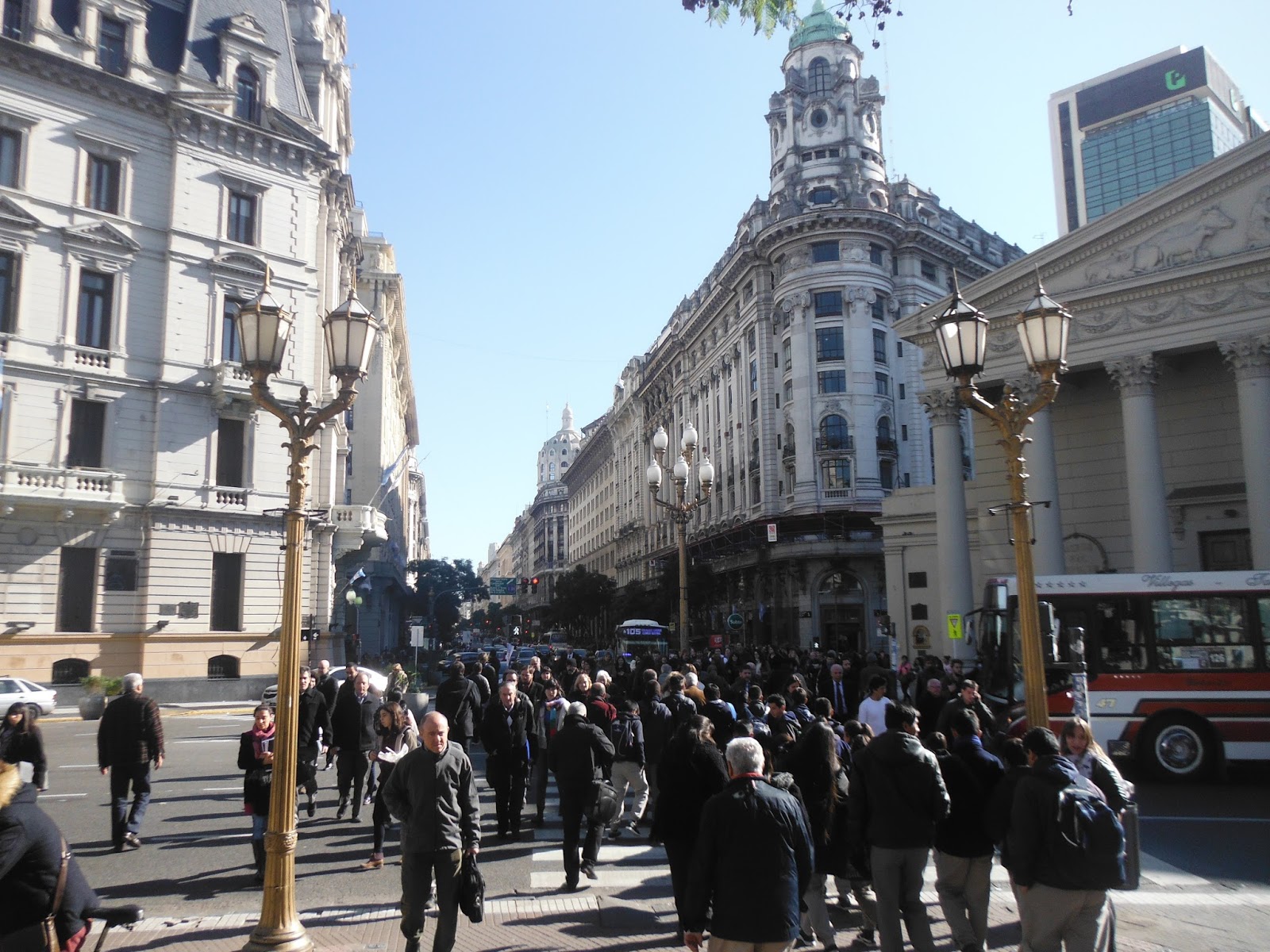
Florida Street
Arriving in Buenos Aires this week has been a shock to the system.  It is now week 4 on the road and I was not prepared for Argentina at all.  So much time away has apparently caused me to be lazy in doing any research before arriving somewhere new but the element of surprise has it advantages.  I came across the Rio de Là Plata (the body of water that separates Uruguay and Argentina) by ferry and it was one of the most enjoyable ways to travel that I have done in awhile.  I could not believe the difference in the cities that are so geographically similiar.   Buenos Aires is noisy, crowded, grimy and beautiful all at the same time.There are little less than 3 million people in the city and the first time I left my hotel for a walk, it felt like half of them were on the same street that I was.  After being in Uruguay where the entire country has a population of 3.4 million, I wasn’t mentally prepared for this at all.  

Beef hanging in a local butcher shop
Beef certainly remains king here, it takes up at least 75% of retail space in all the grocery stores I have been in and proudly states that it is product of Argentina.  Argentina also claims to be the second largest consumers of beef in the world (I am still looking for a good source to confirm this). Beef is the headliner on every restaurant menu from burgers, steaks, pasta dishes and empanadas.  As part of the consumer research component of my Nuffield study, I feel that is my duty to try as many of these dishes as possible and nothing has disappointed yet.  Don’t even get me started on the desserts here….they are fantastic beyond anything I have had before and I am already thinking about how much I will miss them when I return home.


I am staying at a hotel in the Palermo Hollywood district of Buenos Aires.  It is quieter here than in the downtown district and there are many more trees around which makes me like this neighbourhood even more.  My attitude towards the city is softening somewhat. Palermo Hollywood is the so- called neighbourhood where people go to be seen and for gastronomic delights; it houses the city’s greatest concentration of bars and restaurants.  Even though I am here for but just a few days before heading out to the countryside, it is my quest to try as many of the restaurants and beef dishes as possible.  I am luckily back again next week for more while I visit the famed La Rural Show, held right here in Palermo district.  Where country comes to the city: Argentina style.
Casa Rosada; allegedly painted with cow's blood


Saturday, July 11, 2015

South of Brazil...North of Argentina

   My time in Uruguay is quickly coming to an end.  I have enjoyed this leg of my trip very much.  Uruguay is a beautiful country which varied landscapes and stunning views and I say that while I am seeing it at its worst; it is the middle of winter and half of the country is in a state of emergency due to drought.  It seems as though this little country sandwiched between Brazil and Argentina is an overlooked diamond in the rough.
   Uruguay is a beef country, they are the second highest beef consumers int he world at 53 kg/person/year and export 75% of the beef they produce.  There is also a thriving dairy industry and byproducts like leather goods are abundant.  Their beef is fully traceable through an electronic database and their tags are provided to producers at no cost.  

Information has been tough to come by; apparently my lack of Spanish language skills and a wariness of foreigners in this developing nation meant that I was not able to meet with the industry groups that I had hoped to.  Even the Angus Association has not responded to my requests but that is part of the fun of doing a Nuffield study, if everything was easy than it wouldn’t be as exciting.  I did manage to catch up with one Angus producer who is Uruguayan and originally from the UK.  He was a wealth of information and I always appreciate the chance to look at some great Angus cattle.


   I also did something which is mostly likely a once in this world experience, I stumbled upon the Museo de la Revolución Industrial in Fray Bentos (left).  A museum dedicated to the production of beef bouillon and processed meats, yes that is correct a musuem dedicated to a meat processing company in an old kill plant.  
   Even though Uruguay was not at all what I was expecting it has been a fantastic week and I am a little sad to leave.  Perhaps I’ll be back soon, this does seem like an ideal place to invest in a little beach front property, I just need to start working on my Spanish.


Punta del Este
Plaza Independencia, Montevideo