Friday, January 27, 2017

Dunamase Castle Off my List


Have you ever seen something on tv or read about about a place that you absolutely had to add to your own wanderlust list?  Do you ever follow through and actually visit those places?  Like most travel junkies my list of places to visit and sites to see is long and ever expanding.  I consult it when I am planning a trip and sometimes even use that list to determine where I want to visit next.  It is a valuable tool to help travel enthusiasts and wanna-be travellers to keep organized.  I use a simple spreadsheet program to keep mine organized, I also have a bit of an obsession with spreadsheets. 

I recently had the chance to cross one of items off my list.  It was a recent addition that I added after watching "Tales of Irish Castles" on Netflix over the summer.  One of the episodes was focused on Dunamase Castle, a ruin on the edge of Dublin in County Laois, perched atop the Rock of Dunamase at 46 meters (151 feet) above the flat plain where even on an overcast day you can see for kilometres.   
While the castle lays in ruins it is still an excellent example of a Norman Castle dating back to the 12th century.  As a Canadian, where we are celebrating 150 years as a country, it is hard to wrap my head around the age of something built nine centuries ago.  

Designated as a National Monument of Ireland, it is open 24 hours a day to the public and well worth the detour off the N80 for a look around or just add it to your list.  What’s on your wanderlust list? 


Tuesday, October 25, 2016

Charlottetown, Prince Edward Island

Over the past year my job has taken me to the Eastern Coast of Canada a few times and this summer I was able to visit Prince Edward Island, Canada’s smallest province for the first time.  PEI is a wonderful place to spend some time in the summer, full of friendly people, historical significance and some of the prettiest scenery in the country it’s easy to get caught up in the relaxed vibe offered. 

Based in Charlottetown for a week, amid meetings and events I took some time to get out and see the city by foot.  The tranquility of a walk along the boardwalk beside the ocean was an excellent way to unwind each evening.  The boardwalk stretches for kilometers along the shoreline providing picture perfect views of red soil, historic homes and national monuments.  There are clearly marked walking trails around the city focusing on different aspects of the culture; painted lines on the sidewalk makes them easy to follow and they vary in length. All of which made it very easy to hit my goal of 10,000 steps a day even with meetings and obligations all day.  

Known as the “Birthplace of Confederation”, Charlottetown’s history is Canada’s history.  The original settlement dates back to a military settlement established in 1720.  It was in the Provincial Legislation Building in the city that the founding fathers of Canada first met to discuss the uniting of Upper Canada and Lower Canada.    


The Eat Local movement is strong on PEI and all restaurants seem to serve fresh seafood and other delights.  There is a strong sense of local pride.  Ask questions, look for labelling and enjoy the fares produced just down the road from where you are eating it.  Patios are ever popular in the city and a lovely way to pass a warm summer night with friends; new or old. 

No visit to PEI is complete without a stop at COWS Ice Cream, which originated on the Island.  The creamy, luxurious ice cream is an indulgence worth having. Labelled as one of the best ice cream’s in the world; there is a flavour to suit every taste and multiple locations around the city and province make it easily accessible.  The COWS Factory on the west side of Charlottetown is an interesting stop to see how the ice cream, cheese, butter and famous t-shirts are made. 

If you haven’t already been go and visit the Island for the history, the natural beauty, the foodie culture or the fact that you can drive around the island in a day.  Just go. 


Saturday, April 2, 2016

First few days in Dubai

I have been in Dubai for three days now and so far it has been nothing like I expected and exactly as I expected:

Coming into the man-made
Dubai marina by ferry
The buildings are big!  So very big and there are so many of them.  The city stretches on for kilometres along the coastline and skyscrapers tower along the water from end to end.

Construction is everywhere and the recent slump in oil prices does not appear to affect it much.  Or perhaps it has and this is what a slump looks like.  The city of Dubai, apart from the historic district, did not exist 20 years ago.

The people are wonderfully friendly and helpful.  English is spoken by everyone I have encountered and all signs are in both Arabic and English.  That has made travelling fairly easy.  I have been asked daily about travelling alone but everyone has been more curious than anything.  It has not been as bad as I had expected.

Gold Souk
ATM machines that dispense gold bars do exist and there are a number of them around the city that I have seen.

It's a hard city to get around without a car.  I supposed a city built around the oil industry would be set up to drive around, walking is hard as everything is spread out and sidewalks are not very common.

People in Dubai do not pay income tax nor is there a value added tax on goods, this was put in place to attract people to work here.

It rains here a lot....well not really but it did yesterday.  All day and the day before had on and off  showers, so much for coming to the desert to get away from rainy Ontario.   Next week is looking better.
Burj Al Arab in the clouds 

Tim Hortons has locations all across the city, feels like home with a coffee shop on every corner.  I can now rest easy that I know what Tim Horton's looks like in Arabic.

Everything strives to be bigger and better but there is very little original architecture.

I found a coffee museum today, all else is irrelevant.


Thursday, March 10, 2016

Nuffield Report is now online


It has been two and half years in the making but my Nuffield Report, the basis for my travels over the past two years is completed, reviewed and published.  I am very proud of this summary of my findings and how it all came together.  Based on everything I experienced I recommend the following for the Canadian beef industry.

  Enhance and expand Product of Canada guidelines and investigate the opportunity for an independent organization to oversee and promote the brand on all commodities
  Track greater data through our national traceability system and by requiring additional information such as a date of birth assigned to every tag
  Have a functional national database to trace value added data and enhance it based on specific branded beef programs needs
  As an unified industry continue to work with foodservice and retail outlets to ensure information they present to consumers is verifiable and accurate
  Enhance and expand regional eat local programs to encourage consumers to source local products and get to know the person behind the food
  Redesign labels on beef products and packaging to provide additional information to consumers
  Ensure beef producers in Canada understand how important traceability and consumer trust is and the need to keep that trust

The full report is available on the Nuffield International website.  Feel free to email me if you have any questions or want to discuss anything in the report with me.

Thursday, February 4, 2016

 As 2016 continues to unfold, I have been able to take some time and reflect on what an incredible journey the past year was.  2015 will forever be the year I finished by Nuffield project, the year I spent an incredible six weeks in South America and the year I moved back to Ontario to farm.  A truly remarkable year and I can’t help but wonder what 2016 will bring.  New challenges, new opportunities and new adventures very likely.  
 My Nuffield report “Should my beef have a barcode?” will be published very soon and that will be my last Nuffield or production type post here, this site moving forward will be devoted to stories and updates on travels around the world.   

 The past two years have seen me travel over 120,000 kilometres on 37 flights and 150  nights away from home.  It has been a roller coaster ride of highs, lows and epic adventures, most of which I have outlined in the posts here.  The rest will only be told only over a few beers.  I want to wish everyone all the best in 2016.  I will add these final words of wisdom to close 2015 “Travel is glamorous only in retrospect” Paul Theroux and “Getting out of your comfort zone can change your life” Arlene Dickinson.

Tuesday, December 22, 2015

Top 10 Travel Moments


Continuing my Top 10 Lists is the ten most incredible things I experienced in the past two years.   Nuffield trips are centred around research, meetings and learning opportunities.  However, mixing in a little fun and filling half a day until the next meeting or coming into a city a day earlier allows for some sight seeing and rest.  I had a number of "can't believe I am here" moments while travelling,  narrowing down this list was a real challenge.

Top 10 Travel Moments:

10.  Random Roadside Attractions, Australia - The Big Guitar, Big Mower, Big Macadamia Nut, Big Pineapple, Big Ayrshire all things I came across while driving down the highway in Australia.

Henry VII's clock, Hampton Court
9.  Cattle Auction, Kostanay, Kazakhstan - While some people may think a cattle auction is not that exciting especially when it is in a language you do not understand, I found it fascinating.  The entire spectacle of the day was incredible as us as Canadian guests were treated as royalty.  A video of lot 1 selling is posted on Youtube.  

8.  In and Around London, United Kingdom - Hampton Court, Jane Austen House, Walking along the Thames River - London and the surrounding area was incredible.  The history and the natural beauty of the area was something to see and I want to go back when I have more time.  

7.  Hong Kong Disneyland - After almost five weeks on the road I and a few days in Hong Kong, I needed a break.  Meetings fell through and I ended up with some time on my hands, what a better way to kill a day then at Disneyland.

6.  Skiing in Santiago, Chile - Conditions may not have been ideal but two days of skiing in the Andes was quite the experience.  The Andes are extensive and rugged and stunning.  

5.  Uruguay - For those of you who I have talked to since I returned home in August, you know how much I loved the Uruguay section of my recent trip.  The city of Montevideo was incredible and the countryside even more so.  This is a country I will return to soon.  


4.  Hiking along the Great Wall of China - On a somewhat clear day which made it even better, then coming down through a small scale traditional farm in the Chinese countryside, it is a day I will not forget.


3.  Sunrise at Uluru, Northern Territory, Australia - I remember this day well, after a bad night sleep in a hostel the last thing I wanted to do that morning was get up before the sun was up and drive over to the viewing area.  But I willed myself to get out of bed that morning and I was glad I did.  The series of photos shows the entire sunrise over Uluru on a beautiful fall morning.


2. Igauzu Falls, Brazil - The pictures of these waterfalls do not do them justice. It is hard to even take them all in let alone describe.  Check out the video.


1.  Eiffel Tower, Paris, France - Paris in the fall in the rain.  It only gets slighty more cliche than that (it could have been the spring) but the sun came out when I arrived at the tower allowing me to take the stairs which was an experience in itself.  An iconic moment at an iconic location.  With one day in Paris it was the only place to go.


Friday, October 16, 2015

Top 10 Nuffield Visits


As I wrap up writing my report, I have had a lot of time over the past number of weeks to relive my travels and reflect on all that I have experienced in the past two years.  The people I have met, the things I have seen and the once in a lifetime adventures I have had all contribute to the learning experience that is Nuffield Study.  In honour of almost being done phase one of this process I am recapping some top 10 moments.

Top 10 Nuffield Visits:

10.  Alltech Conference, Normandy, France - An excellent conference with new people, interesting ideas and new perspectives.  Not to mention it was a beautiful town in the NorthEast of France and the conference centre was right on the beach.


9.  Allflex Plant Tour - Vitre, France - Staying on the French leg of my travels.  A behind the scenes tour of how ear tags are made was something to see.  


8.  Morning Star Pub - Belfast, Northern Ireland - Ok, I know what you are thinking.  Why did a pub land this low on the list?  It was not about the cider (well not just about the cider), this pub sold the products that they raised on their own farm and sources the rest of their supplies from local producers.  A shining example of how the Taste of Ulster Program can excel.  Not to mention the food was phenomenal.
7.  Nuffield Place, Huntercombe, United Kingdom - No Nuffield trip through the UK is complete without a visit to Lord Nuffield's home.  Learning about the man who starting the Nuffield Scholarship program was a very simple way to show gratitude and a fascinating journey back in time.


6.  SIAL Show, Shanghai, China - Dubbed "Asia's Food Marketplace"  attending this food service trade show was a full on assault on the senses, much like China as a whole, it needs to be seen in person to be appreciated.
 

5.  Beef Processing Plant Tours - In Canada it is a rare treat to get behind the scenes at one of our packing plants and rarer still when the plant is operating but I was able to visit plants in Australia, Northern Ireland and Brazil.  Seeing the traceability systems in these plants and the basic system employed in Brazil was a learning experience all it its own.


4.  Coffee Plantation, near Ribeirão Preto, Brazil - For those of you who know me the only surprise should be that this comes in at number four.  I love coffee but being a Canadian we don't get the chance to grow our own coffee beans.  I visit to a plantation in Central Brazil during harvest was a special treat for this coffee lover.  


3.  Fairs & Exhibitions - Visiting agricultural fairs is something that I have done for a number of years.  I spent a day at a fair in a number of countries; Argentina, Australia, Ireland and United Kingdom.  Seeing how agriculture innovation at each of these events and the youth who are the up and coming farmers is always a treat.  


2.  Contemporary Scholar's Conference, Sydney/Canberra, Australia - The official kick off event for all new Nuffield Scholar's, it is also the only chance that all the 2014 Scholar from around the world get together in one place.  Meeting so many great people in one place in one week was something else.


1.  On Farm Visits- By far the highlight of all my trips.  Whether it was pasture tours in Argentina, a day with Mr. Li in Qingdao, China or sitting down at the kitchen table to discuss ideas and swap Nuffield stories.  The face to face meetings with fellow scholars, current and past is the best part of the experience.  Nuffielders are innovative, optimistic, passionate people about agriculture and from that great conversations occur.  


Tuesday, August 4, 2015

The Nuffield Experience

My last Nuffield trip is now in the books; the suitcase is unpacked and life is slowly returning to normal.  Writing my report and presenting at the Nuffield Canada AGM in November are all that is left to do to complete my Nuffield requirements.  While a Nuffield journey never really ends, this first important stage is almost over.  I am having a hard time wrapping my head around this new reality.  It has been such a big part of life for the past 24 months (almost exactly 2 years since I got the call).  A Nuffield scholarship is not about the research, or the miles logged, the meetings taken or the ability to cram as much in as possible.  It’s about visiting people and places not as a tourist but as a friend.  It’s focus is talking with people and learning from them rather than just racking stats up on a tally sheet (for those who are curious I am still compiling stats) and it honestly is the best way to get to know all that is great about a country. 

Nuffield is also a community.  I have experienced this first hand.  The Nuffield International community is like nothing I have seen or heard of before.  It amazed me time and time again how people I didn’t know, would drop everything to show me around for a few days and usually on the drop of a dime.  It was based on nothing but an email and the mention of the magic word….Nuffield.  Many of them went above and beyond just showing me around, they invited me into their homes, gave me the keys to their truck and have shown me the time of my life.  It is amazing.  Truly awe inspiring and humbling.  

One question plaguing me on my travels time and time again.  How do I repay something like this?  There is no way in the moment.  As a traveller you are limited in your ability to do any justice to the act.  The more I travelled and thought about it the more I realized the answer was rather simple.  I suppose the only way is to pay it forward; answer the email when it arrives, invite the next scholar into your home, give them the keys to your truck if needed and show them everything that is great about your region and your country.  

The people who have helped me along the way are too numerous to mention here but I will include everyone in my final report.  I am forever grateful to every one of you and hope to welcome you all into my home one day.  


If you have been following my travels and ever thought a pang of jealously or envy (come on now, I know you have) apply for a Nuffield.  Anything is possible.  Applications are due April 30th each year, start thinking and planning now.  This time next year this could be you.  Visit www.nuffieldcanada.ca for more information or contact me directly. 

Twitter/Instagram:  @CherylHazenberg
Email:  cheryl.hazenberg@gmail.com


Thursday, July 30, 2015

Skiing in July

I decided to take a few days at the end of this trip and hit the slopes near Santiago, Chile.  My Nuffield travels are over now and these last few days were a break before heading back to work and to the farm.  It was an opportunity to ski the Andes and to ski in July.  I am only in Chile for 5 days, staying exclusively in the city of Santiago and hitting the slopes for two days.  My destination were the El Colorado and Valle Nevado ski resorts about 30 km east of the city.  


This is near the bottom, traffic was stopped for 30 mins
due to an accident 2 turns above us.  Apparently this
rarely happens.
The resorts may only be 30 km away but it takes over an hour to get up there.  The road is steep and twists around 40 hairpin turns.  It's like the road up to Mt. Norquay in Banff only 20 km long, paved and with much more traffic.  It is a two lane road but during ski season traffic can only go up it for a few hours in the morning and down for a few hours in the evening.  The rest of the time it is open for both directions.

Last season was a recording setting year for these resorts, they experience an extra long ski season and had heaps of snow.  This year they are paying for that great experience.  It has been a very dry winter so far and Valle Nevado just opened on July 15th.  They typically can open early in June, six weeks late this year and I expect they barely had enough snow to open when they did.  No new snow has fallen since before they opened and the daytime temperature is getting above zero routinely.  Needless to say, conditions were not ideal. However, you have to make the most of situations like this and I can still say that I have skied the Andes.  Adverse conditions make for a better skier and it felt great to get some runs in.

These past few days in Chile I have encountered more people who speak english than anywhere else I have been on this trip.  The people are so friendly and helpful.  Santiago is easy to get around on the subway and there are many options for getting out into the mountains for hiking and skiing.  I only wish I had more time.

There is snow in the forecast so hopefully they can make something out of the winter here yet and I’ll just need to come back.

The road to Valle Nevado, along the ridge.


Tuesday, July 28, 2015

Traceability in Uruguay and Argentina


Both countries have sophisticated, intense animal traceability systems. Both countries use a two tag approach with one tag being an EID and the other a visual tag. Farms identification as well as premise identification is coded into the tag numbers and in Argentina the region is also included.  

Uruguay uses an online based system where approved professionals and farmers themselves can input specific pieces of data into the system.  Animals have to be tagged and recorded prior to six months of age; mandatory information is date of birth and sex linked to a tag number.  Movements are also tracked, animals have to be inspected by an approved official (usually a vet at the cost of the producer) to read the tag numbers and submit the request for movement to the government.  The movement is recorded and hard copies of the information is sent with the truck as well.  Completed vaccines are also recorded in the same database; brucellosis and foot and mouth vaccines are required in Uruguay.  Tags are provided free by the government at least for right now.  Uruguay also tracks beef after processing through to the consumer.  Their system is relatively new and was adopted for export purposes.

Argentina is similar by the fact that they track all animal movements.  They do not require inspection prior to the move but the producer is responsible for recording the information regional office a few days prior.  The government has offices is almost every town and larger offices overseeing each region.  The government workers recently returned to work from a strike when I was there and it meant that no cattle could be moved during the strike.  There is no user interface in their database for producers to record their own movements.   Producers pay for the tags and to record movements; movements between farms cost $10.00 CAD per truck and it is $78.00 CAD per truck to take animals to a plant.  The tags only cost them about $2.00 CAD each.  Once the tag is removed at harvest individual traceability is done.  Beef is tracked by lot back to the truck it arrived on however and remains fully traceable as a group.  
  
This enhanced system has been in place for about ten years.  It was developed solely to serve their customer, the European market. The Argentina traceability system includes cattle, sheep, pigs, deer, horses, chickens (commercial) and bees.  The gentleman I was meeting with must have seen the shock on my face when he said bees.  He was quick to clarify that it’s the hives that are tagged not the individuals.  If the hives are moved to different locations that is all tracked.

Both systems were interesting and impressive in the details they record.  The mandatory vaccination protocols and the necessity to record that information does assist is capturing the additional information.  The producers I spoke with don’t love either system from what I could gather however they have accepted it as part of life now and compliance is 100% as there is no way to sell the animals without them being part of a national database.

For information on Brazil's traceability system, visit the post - Brazil Part 4 - Beef 

Sunday, July 26, 2015

Opening Day at Palermo

Mascots
Exposition Rural 2015; La Rural; Palermo Show.  No matter what you call it, it is an event not to be missed in the Argentina agricultural calendar.  The best of the best are on display in Buenos Aires each July.  All I had to do was say I was headed to Buenos Aires this week around beef producers and they would say “Palermo”.  Even outside Argentina the show has a reputation .  Many Canadians are familiar with it and were Brazilians and Uruguayans who I spoke with.

I was there on opening day.  Not exactly the best time for cattle enthusiasts but by the time the Angus show starts next week I will be home in Ontario and I have one more country to visit first.  My reign as the queen of bad timing continues but I saw a lot and I always like to have a reason to come back and visit a country again.  

Not everyone is a lover of cattle shows I know; but there is something about the atmosphere at these events that I cannot get enough of.  The optimism, excitement and joy in the air is contagious.  I’ve attended a number of shows through my Nuffield travels and I've noticed it at all of them.  I believe expo's give a good impression of agriculture in the region.  The newest and best equipment is always on the display.  The very best livestock are prepared and presented and the people are always warm and like to chat.  

That's what I call a food truck!
I am also a believer in the good that Exhibitions do to promote agricultural awareness with our urban-living friends.  The agricultural community talks often of “bridging the gap” and “consumer education”, these exhibitions do just that.  It allows consumers to interact with the people who produce food especially livestock producers in a way that they are as excited to participate in as we are. 

For more information, visit www.exposicionrural.com.ar


The ring.


The Angus booth

Friday, July 24, 2015

Buena Noches from Argentina

Argentina is an excellent environment for raising beef cattle.  Their wide open flat plains which stretch for 100’s of kilometres afford a variety of soil conditions for growing native grass, artificial pasture (planted, alfalfa, clover, triticale etc) and crops.  The only set back seems to be the inability of the soil to drain when it rains and the potential for water laying around.  

The cattle are a moderate size but excellent quality and in the Pampas region 80% or more of the animals are Angus.  Calving begins in August and most facilities are set up as birth to slaughter and cattle are raised entirely on grass unless supplemental grain is needed in a bad year.  Feedlots are beginning to dot the landscape and a growing percentage of beef is finished this way.  

Operations are large, labour is inexpensive and the majority of work is done by the gauchos on horseback.  The system allows them to raise high quality beef in a low cost model.  Crops are planted in areas of the farms with good soil and serve as a method of diversified income to the farm.


 All of the farms I visited with are part of a group who all have the same management consultant.  There are 12 farms involved in total and they get together once a month to share ideas.  Each farm takes a turn at hosting the meeting and it turns into an all day event.  The farms share all their information including financial data and provide constructive criticism, news, and solutions to problems others are facing.  I ran across a similar system in both Australia and Ireland.  I think these types of groups are important for farmers to be a part of.  Perhaps this is something the beef industry in Canada needs to take a closer look at? 


My trip is nearly done now.  My official Nuffield travels are also coming to a close.  It is a little sad but on the other hand I am excited to begin earnestly sharing what I have learned and putting ideas into action on the farm in Ontario. 'Till next time.  

Friday, July 17, 2015

Buenos dias from Buenos Aires

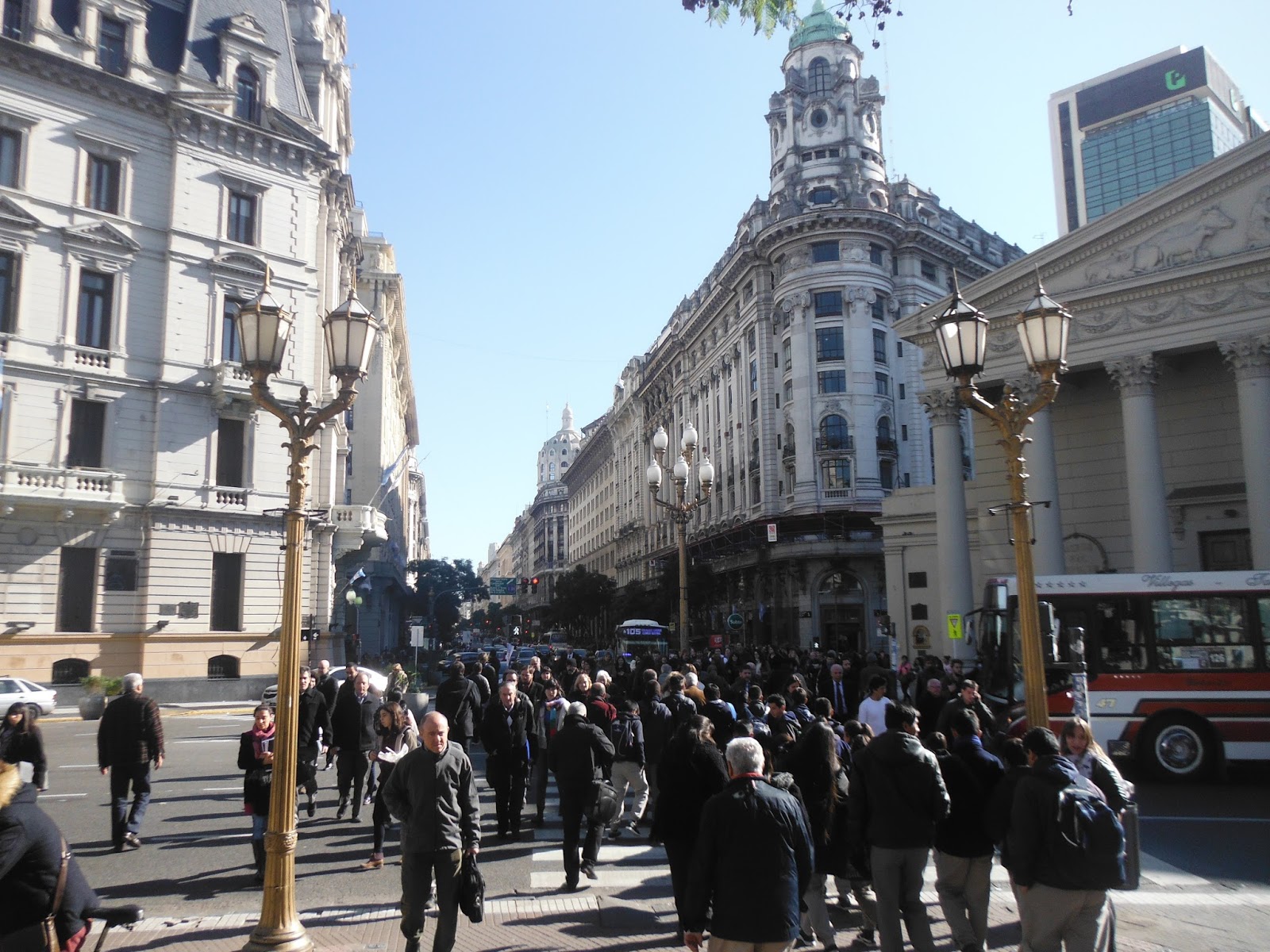
Florida Street
Arriving in Buenos Aires this week has been a shock to the system.  It is now week 4 on the road and I was not prepared for Argentina at all.  So much time away has apparently caused me to be lazy in doing any research before arriving somewhere new but the element of surprise has it advantages.  I came across the Rio de Là Plata (the body of water that separates Uruguay and Argentina) by ferry and it was one of the most enjoyable ways to travel that I have done in awhile.  I could not believe the difference in the cities that are so geographically similiar.   Buenos Aires is noisy, crowded, grimy and beautiful all at the same time.There are little less than 3 million people in the city and the first time I left my hotel for a walk, it felt like half of them were on the same street that I was.  After being in Uruguay where the entire country has a population of 3.4 million, I wasn’t mentally prepared for this at all.  

Beef hanging in a local butcher shop
Beef certainly remains king here, it takes up at least 75% of retail space in all the grocery stores I have been in and proudly states that it is product of Argentina.  Argentina also claims to be the second largest consumers of beef in the world (I am still looking for a good source to confirm this). Beef is the headliner on every restaurant menu from burgers, steaks, pasta dishes and empanadas.  As part of the consumer research component of my Nuffield study, I feel that is my duty to try as many of these dishes as possible and nothing has disappointed yet.  Don’t even get me started on the desserts here….they are fantastic beyond anything I have had before and I am already thinking about how much I will miss them when I return home.


I am staying at a hotel in the Palermo Hollywood district of Buenos Aires.  It is quieter here than in the downtown district and there are many more trees around which makes me like this neighbourhood even more.  My attitude towards the city is softening somewhat. Palermo Hollywood is the so- called neighbourhood where people go to be seen and for gastronomic delights; it houses the city’s greatest concentration of bars and restaurants.  Even though I am here for but just a few days before heading out to the countryside, it is my quest to try as many of the restaurants and beef dishes as possible.  I am luckily back again next week for more while I visit the famed La Rural Show, held right here in Palermo district.  Where country comes to the city: Argentina style.
Casa Rosada; allegedly painted with cow's blood